January 22, 2026
January 22, 2026 • Hair Routine
Hair thinning rarely happens overnight. It develops slowly as changes occur within the hair growth cycle and follicle environment. This article explains the biology behind thinning hair and why understanding the process leads to more realistic expectations.
Written by Admin
Hair thinning is often misunderstood as a sudden event, but in reality it develops slowly over time. Small changes within individual follicles accumulate, eventually affecting how dense hair appears across the scalp.
Understanding why thinning happens requires a closer look at how the hair growth cycle works and how follicles respond to internal and external influences.
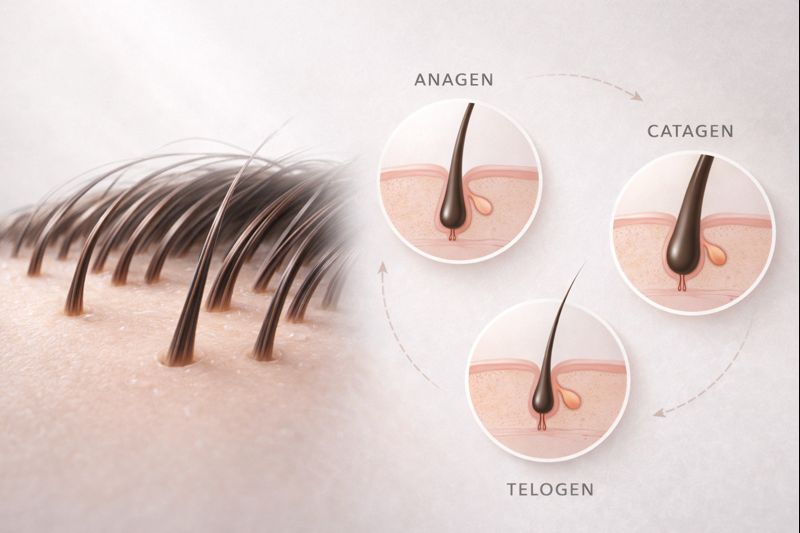
Each hair follicle operates independently and moves through a repeating cycle made up of three main phases: growth, transition, and rest. This cycle determines how long hair grows, when it sheds, and how thick each strand becomes.
The anagen phase is when hair actively grows. This phase can last several years, and its length plays a major role in overall hair density. When this phase shortens, hairs do not grow as long or as thick as before.
During the catagen phase, hair growth slows and the follicle begins to detach from its blood supply. This short phase prepares the follicle for rest.
In the telogen phase, hair remains in place but no longer grows. Eventually, the strand sheds and the follicle either re-enters the growth phase or remains inactive for longer periods.
Hair thinning often occurs when follicles repeatedly spend less time in the growth phase and more time in the resting phase. Over time, this results in shorter, finer hairs replacing thicker ones.
These changes do not mean follicles disappear immediately. Instead, their output gradually diminishes, which explains why thinning tends to progress slowly.
The scalp provides the environment in which follicles operate. Factors such as buildup, irritation, and reduced circulation can influence how efficiently follicles function.
Maintaining scalp balance supports normal follicle activity. Educational resources from Rapid Infuse often emphasize the importance of scalp-focused routines for this reason.
Hair thinning does not look the same for everyone. Some people notice widening parts, others see reduced density at the crown, while some experience thinning along the hairline.
These patterns reflect differences in follicle sensitivity, growth cycles, and external stressors rather than a single universal cause.
Because thinning develops gradually, approaches that emphasize consistency tend to align better with hair biology. Controlled routines that support the scalp and follicles work alongside natural growth cycles rather than attempting to override them.
This is why consistency-driven systems, such as the Rapid Infuse Hair Regrowth System, are designed around repeatable use rather than aggressive, short-term intervention.
Hair thinning is the result of slow, cumulative changes within the hair growth cycle and follicle environment. Understanding this process helps reduce frustration and unrealistic expectations.
By supporting scalp health, respecting natural cycles, and staying consistent, many people can better manage changes in hair appearance over time.
Rapid Infuse
Explore the product designed for consistency — lightweight, fast absorb, and built for everyday use.
Shop Now →